Posts

Improvement of seed production by SISP-B (Semi Intensive Seed Production with Balanidae)

Image
Improvement of seed production by   SISP-B (Semi Intensive Seed Production with Balanidae) Abstract Wild captured cabrilla común ( Paralabrax humeralis ) spawn 19 million eggs and 9 million larvae hatch-out from November 2018 to April 2019. The spawning occurred water temperature 18 to 20 °C mainly. Several SISP ( Semi Intensive Seed Production ) were operated and improved the method. SISP method is different from intensive method as SISP feed natural growing wild copepod instead of rotifer and Artemia that create intensively. Thus SISP not only require several tanks and equipment (pump, filter, UV etc.) but also high level technique and experience. SISP makes anybody produce premium juvenile easily without large investment. Remarkably we found that the larvae eat picoroco nauplius ( Austromegabalanus psittacus ) which nauplius grows bigger and longer than copepod and blue mussel. Also produce picoroco nauplius easier than copepod that collect in coast and just hang in the SI...

DESCRIPCIÓN DE LOS ESTADIOS DE DESARROLLO DE HUEVOS Y LARVAS EN SACO VITELINO DE LA CABRILLA COMÚN (Paralabrax humeralis)

Image
DESCRIPCIÓN DE LOS ESTADIOS DE DESARROLLO DE HUEVOS Y LARVAS EN SACO VITELINO DE LA CABRILLA COMÚN ( Paralabrax humeralis ) Jessica Pizarro1, Masatoshi Futagawa, German Bueno, Juan Pablo Díaz 1 Facultad Recursos Naturales Renovables. Universidad Arturo Prat. Iquique - Chile. jpizarro@unap.cl INTRODUCCIÓN La cabrilla común Paralabrax humeralis (Valenciennes, 1828) es un serránido que habita en áreas costeras rocoso-arenosas desde Ecuador (3° S) hasta la región austral de Chile (33°10' S). Es una especie valorada para el consumo humano en el mercado nacional   chileno, con tendencias decrecientes de su abundancia desde los 80’ de acuerdo a las estadísticas pesqueras. El conocimiento de los estados tempranos de vida de esta especie (e.g. características morfológicas, desarrollo embrionario, período de incubación) son desconocidos, constituyendo antecedentes importantes para el desarrollo de un proceso de repoblamiento. El objetivo de este estudio fue conocer y descr...
Image
Marking and tagging for releasing activity Masatoshi FUTAGAWA August 27, 2017 Markers and tags The marking or tagging is essential activity in order to identify the released fish in the field. According to identification, we evaluate the activity such as growth, survival, migration of the fish at field and evaluate economic effect. Thus, it is necessary to announce to public that request to inform catch data about tag code, location and size of fish. ·          Nasal septum defect : Some hatchery made fish shows nasal septum defect, nose holes are connected. The data have to revising by the defect rate of the released fish batch. ·          Plucking fins / spines : Pluck ventral, pectoral fin or spine at dorsal fin. The method does not harm any survival and growth according to the paper . Even so, the mark recover within few years. ...
Image
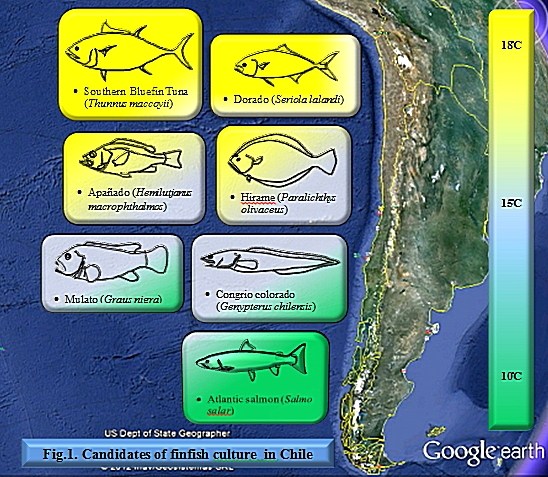
The strategy of f infish culture founding in Chile (Revised version of April 28, 2012) Masatoshi FUTAGAWA August 9, 2017 Exportation of salmons and trout reduced to 513 thousand tons (-13%) and 3.8 billion USD (+8%) in 2016 compare to 2015 due to influence of toxic algae bloom.  Also, natural resource of coastal fishes are decreasing much due to overfishing, and affect costal life which happening in all over the world. Thus, it needs alternatives culture species of salmons to minimize risk of the business and recover resource of costal fishes to improve costal life. The keywords are “Economical sustainability”, “Minimum influence for nature” and “Less energy consumption”. 1.     Conditions 1.1. Fish characters Ideal habits for commercial culture are bellow. ·          Easy to produce juvenile ·          Grow fast; grow to marketable size in a minimum time · ...

Mass mortality of anchovy at Ex Ballenera Iquique, Chile

Image
Mass mortality of anchovy at Ex Ballenera Iquique, Chile October 16, 2016 Masatoshi Futagawa There are many anchovies washed shores at Ex ballenera Iquique Chile on the afternoon October 15, 2016. Those anchovy show weak condition, still alive when the fish reached to the beach. It smelled rotten fish odor and many birds gathered at the area who take those anchovy. The same incident occurred that 600 ton of anchovy dead at Oueule, south of Chile, on last July. Additionally, we observe many birds at surface along Iquique coast that suggest possibly same incident occurring since last month.       I collected some live samples, 4 males and 4 females (TL 12 – 13 cm) at the beach. Based on the optical observation, not using microscope, the fishes show clean and fresh gills and matured, gonad color orange, and intestine has contents.           According to the observation, suspected reasons of the incident are as follows. ...