Posts

Showing posts with the label semi intensive seed production

Study of recirculation semi Intensive Seed Production (RESISP) 1208

Image
Study of Recirculation Semi Intensive Seed Production (RESISP) 1208 Masatoshi FUTAGAWA/CORDUNAP September 30, 2012 The trial of RSISPC (Recirculation semi intensive seed production with copepod) was conducted from August 26 to September 26 2012. Production of phytoplankton failed due to cloudy weather and the water wasn’t circulated due to low production. The experiment terminated on 42 days culture (DC). Even so, there are some copepods and nauplii were produced. RESISP1208 Initial water was introduced through 120 µm bag-net, filled up 20 m 3 , and cultured high density T- Isochrysis (30 L) was added at 0 DC on August 16, 2012. Fertilizer, potassium nitrate (15-0-14, 3ppm) and triple superphosphate (0-14-0, 0.5 ppm) were applied until 9 DC and submersible light (400W) operated 18:00 to 7:00 until 12 DC. Water was supplied 5 % per day and increased 10 to 20 % when pH rise over 8.4 from 14 to 21 DC. Bag-net was removed on 16 DC. Average water temperature and pH at 10...
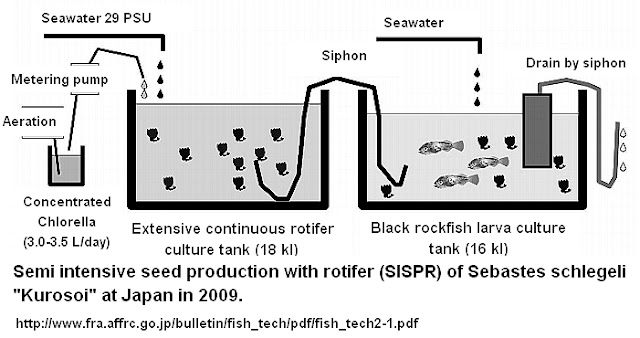
Introduction of SISPR (Semi-intensive seed production with rotifer)

Image
Introduction of SISPR (Semi-intensive seed production with rotifer) Masatoshi FUTAGAWA / CORDUNAP September 23, 2012 Recently, the combination of SISP (Semi Intensive Seed Production) and CERC (Continued Extensive Rotifer Culture) improve seed quality, survival and reduced cost with black rockfish (P49-55, 2009) , Pacific cod (2011) and sea bream (2011). The method (SISPR; semi intensive seed production with rotifer) shows that larva culture at harvest tank of CERC with or without enrichment rotifer. The advantages are produced strong larva, grow faster with less work activities compared to intensive method. I recommend the system consisting 2 units of Rotifer tank and Larva tank (10 kl), cylinder type (3.6 diameter, 1 m depth), sea and fresh water supply for Rotifer tanks, sea water supply for Larva tank, heating system for Rotifer tank, air stone (4 units) for both tank. Rotifer culture water is controlled to 28 ̊C and 29 psu by heater, sea and fresh water supp...

Scallop seed production by SISP

Image
Raw see water was introduced in 20 tons cylinder tank at Arturo Prat University Marine Science laboratory in Iquique Chile in September 22, 2011. Agriculture fertilizers, nitrate 159 g and phosphate 27 g, were applied at 20 tons of water volume at Day 1. Sea water supplied daily at approximately 10 % water exchange rate. Phytoplankton were bloomed and water color turned to green. Copepoda observed at density of 0.2 ind/ml at Day 20. Scallop larvae (Day 1, 16 million approximately) stocked and installed juvenile collectors, 24 bags, at Day 21 in October 13.

Anchovy seed production w/ SISP

Image
According to the my log in Aug. 30, I produced anchovy juvenile with SIPS (Semi Intensive Seed production) and it harvested at Day 52 (52 days post hatch-out) on Sept. 24, 2011. We collected 258 juveniles (TL 41.7 mm, SL 35.4 mm, BW 0.31 g) and survival rate shows 1.5 %. Average water temperature shows 16.8 C during the culture period (75 days). Raw sea water introduced to tank (60 tons concrete rectangle) at 50 % of volume through 1 mm mesh bag net in July 11. The water are supplied gradually and filled up to 60 tons within  a week and during this time agricultural fertilizers (Nitrate 3 ppm and Phosphate 0.5 ppm) are applied four times to increase phytoplankton bloom. The water color changed to green at first week and then it sift to brown one. Even so, the transparency never reached to less than 1m. Several species of Copepods are bloomed from 7th week and those are observed that accumulated at surface during the morning time.   Anchovy broodstock ...

Yellowtail amberjack seed production with SISP

Image
I received Yellowtail amberjack larvae (Day 4, 3,385 ind., TL 5mm) in Feb. 17, 2010. The larvae stock in two conical tanks (500L) and supplied water from SISP (Semi-intensive seed production) tank which include natural copepods bloomed until D34 (30 days). Additionally, we fed mussel larva from D5 to D7, Artemia (D12 to D54) and artificial feeds (Otohime) from D18. The juveniles (D35, 34 ind., TL 35mm) were transferred to square tank (750L) and supplied filtered water and fed artificial feeds. Finally, juveniles (17 ind., TL 51mm, BW 1.6g) were suddenly dead on D58. Average water temperature and pH show 20.6 and 8.28 during culture period accordingly. 

Anchovy seed production

Image
Wild anchovy ( Engraulis ringens ) are collected a off-Iquique and stocked at Arturo Prat Univ. Marine Science Lab at Huaiqique in July 31, 2001. The fish spawned at night in same day, forms oval (1.2x0.6mm), floating surface, and 25,618 eggs are incubated in conical tank. The eggs hatched-out 55 hours after fertilization at WT 15 C approximately. Hatch-out rate shows 80 % and 16,771 larvae (Day1) were stocked in 60 ton tank and rearing with SISP (Semi-Intensive Seed Production) method in August 4.