Posts

Showing posts with the label larviculture

Sinking death syndrome during finfish larviculture

Image
Sinking death syndrome during finfish larviculture Masatoshi FUTAGAWA / CORDUNAP June 30, 2012 Phenomenon Sinking death syndrome occur during early life stage of finfish larviculture, 3 to 7 days post hatch-out (DPH), that larvae settle on bottom at nighttime mostly and it makes mass mortality due to bacteria contamination and anoxia. Several species has the syndrome and that is one of the bottlenecks of mass production. I had the syndrome during the larviculture of Graus nigra , Pacific beakfish ( Oplegnathus insignis ), Japanese flounder ( Paralichthys olivaceus ) and Grater amberjack ( Seriola dumerili ). Causes Increasing body density Finfish larvae consume yolk and oil droplet few days after hatch-out and change body density. Usually, body density of larvae is heavier than water (1.0236±0.0001 at WT 25 ̊C). According to Teruya et al. 2008 , Greater amberjack larva shows it consume yolk and oil droplet until 4 DPH and body water contents reduce from 2 DPH (93.5...
Why finfish seed production was unsuccessful in Chile.

Image
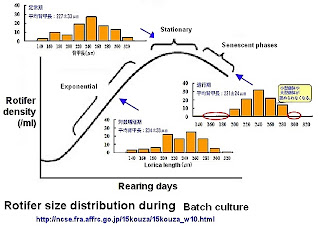
Why finfish seed production w as unsuccessful in Chile Masatoshi FUTAGAWA CORDUNAP February 24, 2012 There were many finfish seed production projects for decades and majority were failure, a few had produced or none. I have some points of view about the reasons why. Major problem is nutrition of rotifer, particularly feeds for rotifer. 1.       Rotifer culture and handling 1.1. Nutritional value Rotifer is commonly used for primary live feeds for fish larva. Chile fish seed production use rotifer which is cultured by bread yeast (SMC, Saccharomyces cerevisiae , 4-7 µm) or marine chlorella (NCO, Nannochloropsis oculata , 2-6 µm ) and feed to fish larva after enrichment. Besides, it is cultured by concentrated freshwater chlorella (CCV12, Chlorella vulgaris , 2-10 µm, 12 billion cells/ml, vitamin B 12 soluble) and NCO. Then it is fed to larva after enrichment in Japan . In 2006, 51 % of hatchery use CCV12 and 92 % use CCV12 and NC...

RESISP (Recirculation Semi Intensive Seed Production)

Image
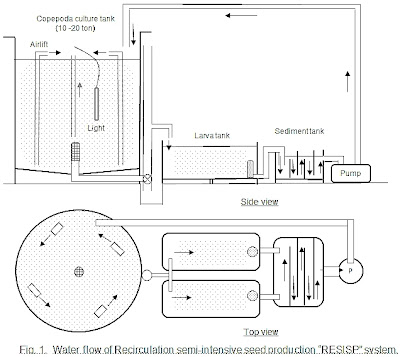
SISP (Semi Intensive Seed Production) had problem which hard to estimate survival due to microalgae bloom, only we knew when dry up. Thus, I improved the system that copepoda culture tank connect to larva tank which shallower than copepoda tank and copepoda culture water recirculate between tanks to give enough feeds, copepoda and phytoplankton and maintain smiler water quality as copepoda tank. Figure of system and comparison among ISP (Intensive Seed Production), SISP and RESISP are below. Table revised on Oct.25.

Scallop seed production by SISP

Image
Raw see water was introduced in 20 tons cylinder tank at Arturo Prat University Marine Science laboratory in Iquique Chile in September 22, 2011. Agriculture fertilizers, nitrate 159 g and phosphate 27 g, were applied at 20 tons of water volume at Day 1. Sea water supplied daily at approximately 10 % water exchange rate. Phytoplankton were bloomed and water color turned to green. Copepoda observed at density of 0.2 ind/ml at Day 20. Scallop larvae (Day 1, 16 million approximately) stocked and installed juvenile collectors, 24 bags, at Day 21 in October 13.

Anchovy seed production w/ SISP

Image
According to the my log in Aug. 30, I produced anchovy juvenile with SIPS (Semi Intensive Seed production) and it harvested at Day 52 (52 days post hatch-out) on Sept. 24, 2011. We collected 258 juveniles (TL 41.7 mm, SL 35.4 mm, BW 0.31 g) and survival rate shows 1.5 %. Average water temperature shows 16.8 C during the culture period (75 days). Raw sea water introduced to tank (60 tons concrete rectangle) at 50 % of volume through 1 mm mesh bag net in July 11. The water are supplied gradually and filled up to 60 tons within  a week and during this time agricultural fertilizers (Nitrate 3 ppm and Phosphate 0.5 ppm) are applied four times to increase phytoplankton bloom. The water color changed to green at first week and then it sift to brown one. Even so, the transparency never reached to less than 1m. Several species of Copepods are bloomed from 7th week and those are observed that accumulated at surface during the morning time.   Anchovy broodstock ...

Yellowtail amberjack seed production with SISP

Image
I received Yellowtail amberjack larvae (Day 4, 3,385 ind., TL 5mm) in Feb. 17, 2010. The larvae stock in two conical tanks (500L) and supplied water from SISP (Semi-intensive seed production) tank which include natural copepods bloomed until D34 (30 days). Additionally, we fed mussel larva from D5 to D7, Artemia (D12 to D54) and artificial feeds (Otohime) from D18. The juveniles (D35, 34 ind., TL 35mm) were transferred to square tank (750L) and supplied filtered water and fed artificial feeds. Finally, juveniles (17 ind., TL 51mm, BW 1.6g) were suddenly dead on D58. Average water temperature and pH show 20.6 and 8.28 during culture period accordingly.