Posts

Showing posts with the label rotifer

Introduction of SISPR (Semi-intensive seed production with rotifer)
Image
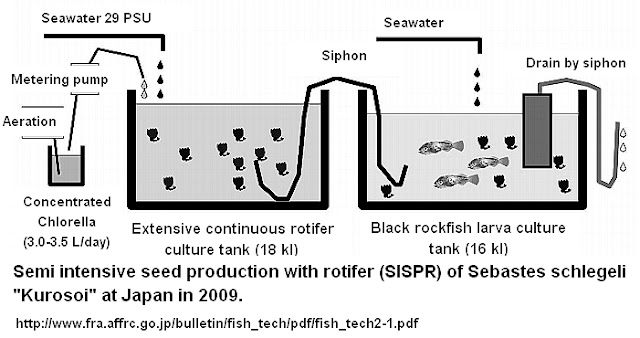
Introduction of SISPR (Semi-intensive seed production with rotifer) Masatoshi FUTAGAWA / CORDUNAP September 23, 2012 Recently, the combination of SISP (Semi Intensive Seed Production) and CERC (Continued Extensive Rotifer Culture) improve seed quality, survival and reduced cost with black rockfish (P49-55, 2009) , Pacific cod (2011) and sea bream (2011). The method (SISPR; semi intensive seed production with rotifer) shows that larva culture at harvest tank of CERC with or without enrichment rotifer. The advantages are produced strong larva, grow faster with less work activities compared to intensive method. I recommend the system consisting 2 units of Rotifer tank and Larva tank (10 kl), cylinder type (3.6 diameter, 1 m depth), sea and fresh water supply for Rotifer tanks, sea water supply for Larva tank, heating system for Rotifer tank, air stone (4 units) for both tank. Rotifer culture water is controlled to 28 ̊C and 29 psu by heater, sea and fresh water supp...
Why finfish seed production was unsuccessful in Chile.

Image
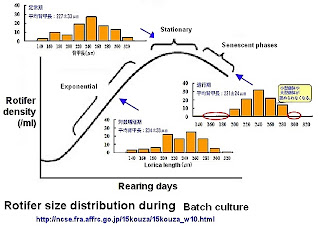
Why finfish seed production w as unsuccessful in Chile Masatoshi FUTAGAWA CORDUNAP February 24, 2012 There were many finfish seed production projects for decades and majority were failure, a few had produced or none. I have some points of view about the reasons why. Major problem is nutrition of rotifer, particularly feeds for rotifer. 1.       Rotifer culture and handling 1.1. Nutritional value Rotifer is commonly used for primary live feeds for fish larva. Chile fish seed production use rotifer which is cultured by bread yeast (SMC, Saccharomyces cerevisiae , 4-7 µm) or marine chlorella (NCO, Nannochloropsis oculata , 2-6 µm ) and feed to fish larva after enrichment. Besides, it is cultured by concentrated freshwater chlorella (CCV12, Chlorella vulgaris , 2-10 µm, 12 billion cells/ml, vitamin B 12 soluble) and NCO. Then it is fed to larva after enrichment in Japan . In 2006, 51 % of hatchery use CCV12 and 92 % use CCV12 and NC...

Technical study of live feeds culture

Image
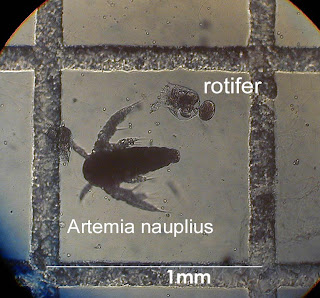
There is the publication of live feeds production for fish seed "-rotifer-culture-tecstu-060829" at http://groups.google.com/toshif . Below is a part of introduction. This technical study is prepared under the project “Optimización de la tecnología de producción de juveniles de San Pedro ( Oplegnathus insignis )” which running with INNOVA-CORFO since 2006. I introduce the culture method of live feeds, rotifer and Artemia. The method shows that rotifer was cultured up to 1300 ind/ml with feed baker’s yeast and ideal density was 800 ind/ml. 魚類種苗生産時に使用する初期餌料生物生産に関する著作物(英文)が、 http://groups.google.com/toshif  の「 -rotifer-culutre-tecstu-060829 」にあります。以下はイントロの一部です。 この技術開発は2006年より始まった INNOVA-CORFO による、プロジェクト「サンペドロ ( Oplegnathus insignis ) (南米産イシダイ)の種苗生産技術の改善」によるもである。これはワムシとアルテミアの生産方法を解説したもので、パン酵母を餌としたワムシ生産では最高13000個 / mlの密度で生産されたが、800個 /ml で良好な生産が見られた。