Posts

Showing posts with the label RESISP

Study of recirculation semi Intensive Seed Production (RESISP) 1208

Image
Study of Recirculation Semi Intensive Seed Production (RESISP) 1208 Masatoshi FUTAGAWA/CORDUNAP September 30, 2012 The trial of RSISPC (Recirculation semi intensive seed production with copepod) was conducted from August 26 to September 26 2012. Production of phytoplankton failed due to cloudy weather and the water wasn’t circulated due to low production. The experiment terminated on 42 days culture (DC). Even so, there are some copepods and nauplii were produced. RESISP1208 Initial water was introduced through 120 µm bag-net, filled up 20 m 3 , and cultured high density T- Isochrysis (30 L) was added at 0 DC on August 16, 2012. Fertilizer, potassium nitrate (15-0-14, 3ppm) and triple superphosphate (0-14-0, 0.5 ppm) were applied until 9 DC and submersible light (400W) operated 18:00 to 7:00 until 12 DC. Water was supplied 5 % per day and increased 10 to 20 % when pH rise over 8.4 from 14 to 21 DC. Bag-net was removed on 16 DC. Average water temperature and pH at 10...

Study of Recirculation Semi Intensive Seed Production (RESISP) 1207

Image
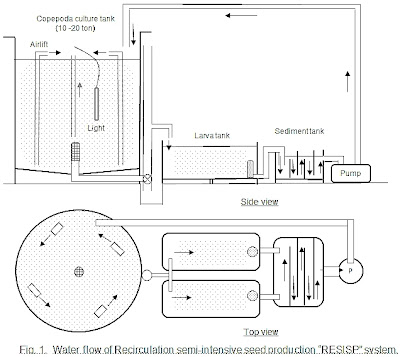
Study of Recirculation Semi Intensive Seed Production (RESISP) 1207 Masatoshi FUTAGAWA / CORDUNAP September 7, 2012 Based on SISP (semi intensive seed production) operation on October 2010, the method had disadvantages of difficulty of larva estimation. The method improved to RESISP that culture water at copepoda tank recirculates to separated larva tank. The trials are conducting from July 2012 and 2 nd trial is running now. There are some observations found and information below. RESISP1207 1 st trial was conducted 23 days from July 28 to August 13, 2012. The system consist copepod tank (20 m 3 ), two larva tanks (1 m 3 ) and pump (0.85kw, 3.8A). Copepod tank equip three air stones at 50 cm depth due to low air pressure, two airlifts (lift up water from bottom) and submersible light (400W). Bottom water was supplied to Larva tank1 and return to copepod tank. Surface water was supplied to Larva tank 2 and drain to outside of the system. Submersible light enhance ...

RESISP (Recirculation Semi Intensive Seed Production)

Image
SISP (Semi Intensive Seed Production) had problem which hard to estimate survival due to microalgae bloom, only we knew when dry up. Thus, I improved the system that copepoda culture tank connect to larva tank which shallower than copepoda tank and copepoda culture water recirculate between tanks to give enough feeds, copepoda and phytoplankton and maintain smiler water quality as copepoda tank. Figure of system and comparison among ISP (Intensive Seed Production), SISP and RESISP are below. Table revised on Oct.25.